
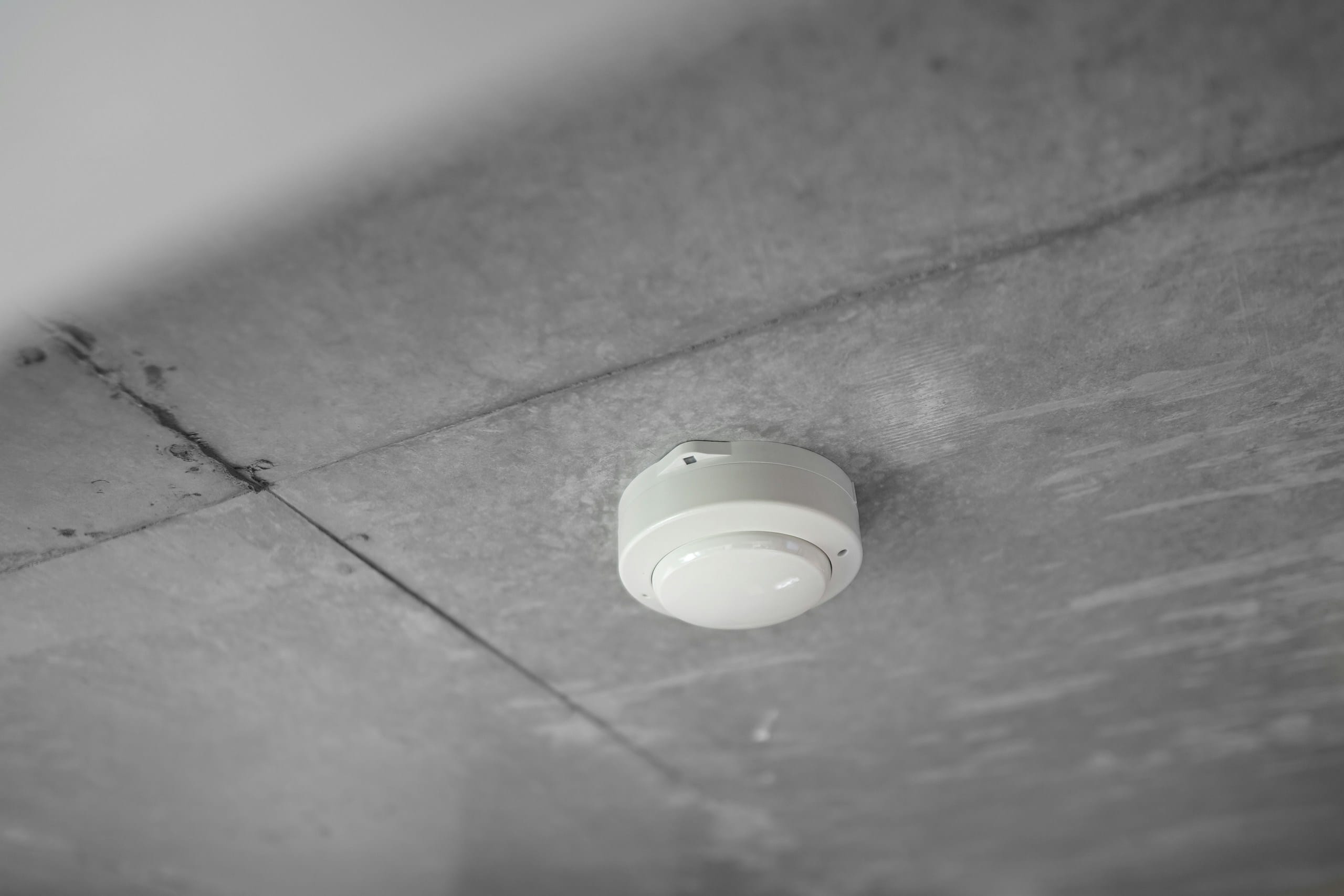
A safer home starts with the right detection.
From smoke and gas detection to intrusion alarms and connected security, we help homeowners identify the right protection for their property. Every recommendation starts with the building, its risks, and the people who live in it.
Four systems, four different jobs
Fire detection warns of fire. Intrusion detection warns of entry. CCTV records what happened. Access control decides who can come in. They protect against different things, so one cannot stand in for another, and a home may need some, all or none of them.
Fire detection
Warns occupants of smoke or heat.
Intrusion alarm
Raises an alert when a door, window or room is breached.
CCTV
Records and lets you view what is happening.
Access control
Manages who can enter, and when.
Explore alarm and safety systems
Choose a category to see what each device does, where it tends to suit, and whether it is a core safety consideration or an optional upgrade.
Detection that gives occupants time to act. Which devices a building needs, and how many, depends on its layout, use and the requirements that apply to it. No home needs every device on this list.
Smoke alarms and smoke detectors
Core safety- What it does
- Sense smoke particles and sound an alarm. Common types use optical or ionisation sensing; a detector may be stand-alone or connected to a panel.
- Where it may suit
- Hallways, landings and areas outside sleeping rooms, and living areas, subject to assessment.
Stand-alone alarms are self-contained. Detectors connected to a control panel are used in larger or more complex systems. Kitchens and bathrooms need extra care because cooking fumes and steam can cause false alarms, so detector type and position are chosen with that in mind.
Interconnected smoke alarms
Core safety- What it does
- Link several alarms, by wire or radio, so that when one detects smoke all of them sound.
- Where it may suit
- Multi-storey homes and larger properties where an alarm on one floor may not be heard on another.
Interconnection helps people hear a warning wherever they are in the building. Wired and wireless links each have trade-offs for reliability, existing finishes and cost, which we discuss during the assessment.
Heat detectors
Depends on the property- What it does
- Respond to a rise in temperature, or a fixed temperature, rather than to smoke.
- Where it may suit
- Places where smoke detectors would give false alarms, such as some kitchens, garages and dusty or steamy spaces.
A heat detector is not a smoke alarm with a different label. It reacts later in a fire, so it complements smoke detection where that suits the room and does not replace it where smoke detection is needed.
Carbon monoxide alarms
Depends on the property- What it does
- Detect carbon monoxide, an odourless gas produced when fuel burns without enough air.
- Where it may suit
- Homes with fuel-burning appliances, attached garages, or generators or engines operated near living areas.
Generators must never run indoors or in enclosed spaces. A carbon monoxide alarm is a warning device, not a substitute for correct appliance installation, ventilation and generator placement.
Alarm sounders and visual notification devices
Depends on the property- What it does
- Make the alarm audible and, where needed, visible, using sounders, beacons or strobes.
- Where it may suit
- Large homes, properties with detached rooms, and households with hearing difficulties.
Audibility is checked in the places people actually sleep and spend time, including with doors closed. Where standard sounders are not enough, additional sounders or visual devices can be considered.
Fire alarm control panels
Depends on the property- What it does
- Monitor connected detectors and call points, show where an alarm originated, and drive sounders.
- Where it may suit
- Larger residences and multi-building properties where a networked, zoned system is justified.
A panel is not needed for every home. It is used where the size or complexity of the property calls for zoned, supervised detection. Power supply and standby battery arrangements are part of the design.
Manual call points
Needs assessment- What it does
- Let a person raise the alarm by hand by breaking a glass or pressing a point.
- Where it may suit
- Where the building’s use and the requirements that apply to it call for them, typically larger or multi-occupancy properties.
Whether manual call points are required depends on the building and how it is used. We do not assume they are needed in an ordinary family home.
Device selection and coverage depend on the building and on the requirements that apply to it. Not every home needs every device listed here, and we do not assume a requirement applies without checking.
Find the right system for your home
Answer a few questions for a preliminary view of what an assessment would cover. It takes about two minutes and nothing is sent until you submit our enquiry form.
Your property
Residential alarm packages
Indicative service scopes, not fixed equipment lists. What is included in your job is set out in the quotation after an assessment.
- 01
Essential Home Safety
For flats and smaller homes
Possible scope
- Smoke-alarm coverage assessment
- Assessment of sleeping areas and escape routes
- Review of relevant gas and combustion hazards
- Installation and testing of selected safety devices
- 02
Home Safety Plus
For family homes and duplexes
Possible scope
- Interconnected smoke alarms where suitable
- Additional hazard detection based on the property’s appliances and layout
- Assessment of alarm audibility and backup arrangements
- Testing and handover
- 03
Home Security
For homes requiring intrusion detection
Possible scope
- Alarm control panel or hub
- Door and window contacts
- Selected motion detectors
- Siren
- Backup power
- Remote notifications where supported
- 04
Smart Home Protection
For premium residences
Possible scope
- Integrated alarm and security planning
- Selected hazard sensors
- CCTV and access-control integration
- Supported smart-home control
- Remote notifications and system testing
- 05
Large Residence Protection
For large houses and multi-building properties
Possible scope
- Site-specific zoning and device selection
- Appropriate alarm coverage
- Power and communication resilience
- Integration with other building systems where justified
- Documented testing and commissioning
Packages are indicative and not compulsory. Prices are not published here; request a quotation and we will scope it against your property.
From assessment to ongoing support
The final scope depends on a site assessment and the building’s actual requirements.
Assess
We walk the property, look at how it is used and what is already installed, and note the risks that matter most.
Design
We propose a layout and equipment list for your approval. Final scope depends on what the assessment finds.
Install
Devices, cabling and power are installed to the agreed design and the manufacturer’s instructions.
Test and hand over
Every device is tested and the system is explained to you. Documentation is provided as agreed in the scope.
Support and maintain
Alarms need periodic testing and battery replacement. We can support ongoing checks and servicing.
23 electrical service lines from one engineering team
15+ years of combined engineering experience
4.8★ Google rating from 192+ reviews
1000+ projects completed
Related services
- Fire detection systems →Panels, detectors and evacuation signalling for larger or more complex buildings.
- CCTV and security systems →Cameras, recording and remote viewing, planned alongside your alarm.
- Home automation →Lighting, control and scenes that can work with supported safety devices.
- Automated gates and access control →Gates, intercoms and controlled entry for homes and estates.
- Residential services →How we work in homes, from wiring to solar and security.
- Book a site visit →Choose a time for an on-site assessment.
Common questions
Which alarms should a Nigerian home have?
It depends on the home. Most households benefit from smoke detection, and many add intruder detection. Gas, carbon monoxide and water-leak devices are chosen where there is a specific risk, such as gas appliances, a generator near living areas, or tanks and pumps. We do not recommend every device for every home; an assessment identifies what is appropriate for yours.
What is the difference between a smoke alarm and a heat detector?
A smoke alarm senses smoke particles, while a heat detector responds to temperature. Heat detectors react later in a fire, so they are used where smoke detectors would give false alarms, such as some kitchens, and they complement smoke detection where it suits the room.
Should a home have a carbon monoxide alarm?
Where there are fuel-burning appliances, an attached garage, or a generator or engine nearby, a carbon monoxide alarm is worth considering. It is a warning device, not a fix: generators must never run indoors or in enclosed spaces, and appliances need correct installation and ventilation.
Can an alarm operate during a power outage?
Alarm systems are normally designed with a backup battery so they keep working when mains power is lost. How long they last depends on the battery and the devices connected, so backup arrangements are confirmed during the assessment. Batteries also need periodic replacement.
Can I receive alerts on my phone?
Often, yes, where the equipment supports it, using a mobile-network (GSM) or internet (IP) communicator. Whether it works reliably depends on signal and internet quality at your property, which we check on site, and on service from your network provider.
Can alarms be installed in an existing building?
Yes. Wireless or hybrid systems can limit disruption in an occupied or finished home, while wired systems suit new builds and renovations. The right choice depends on the building and is confirmed on site.
Can CCTV and an intruder alarm work together?
Yes, and they complement each other: the alarm raises the alert and the cameras record what happened. They are different systems with different jobs, and one is not a substitute for the other. Planning them together makes power, cabling and any integration simpler.
Does every property need the same number of detectors?
No. The number and placement of devices depend on the layout, the rooms, how the building is used and the requirements that apply to it. We do not quote detector quantities from an online questionnaire; they are confirmed at assessment.
How often should the system be tested?
Follow the manufacturer’s instructions for each device. As a general practice, alarms are tested regularly and batteries replaced when they near the end of their life. We can advise on a testing routine for your system and offer servicing.
How do I request an assessment?
Use the questionnaire on this page and continue to our enquiry form, call us, or book a site visit. Nothing is sent until you submit the enquiry form yourself.
Ready for a home safety assessment?
Tell us about your property and what worries you most. We will look at it properly and come back with a scoped assessment.