
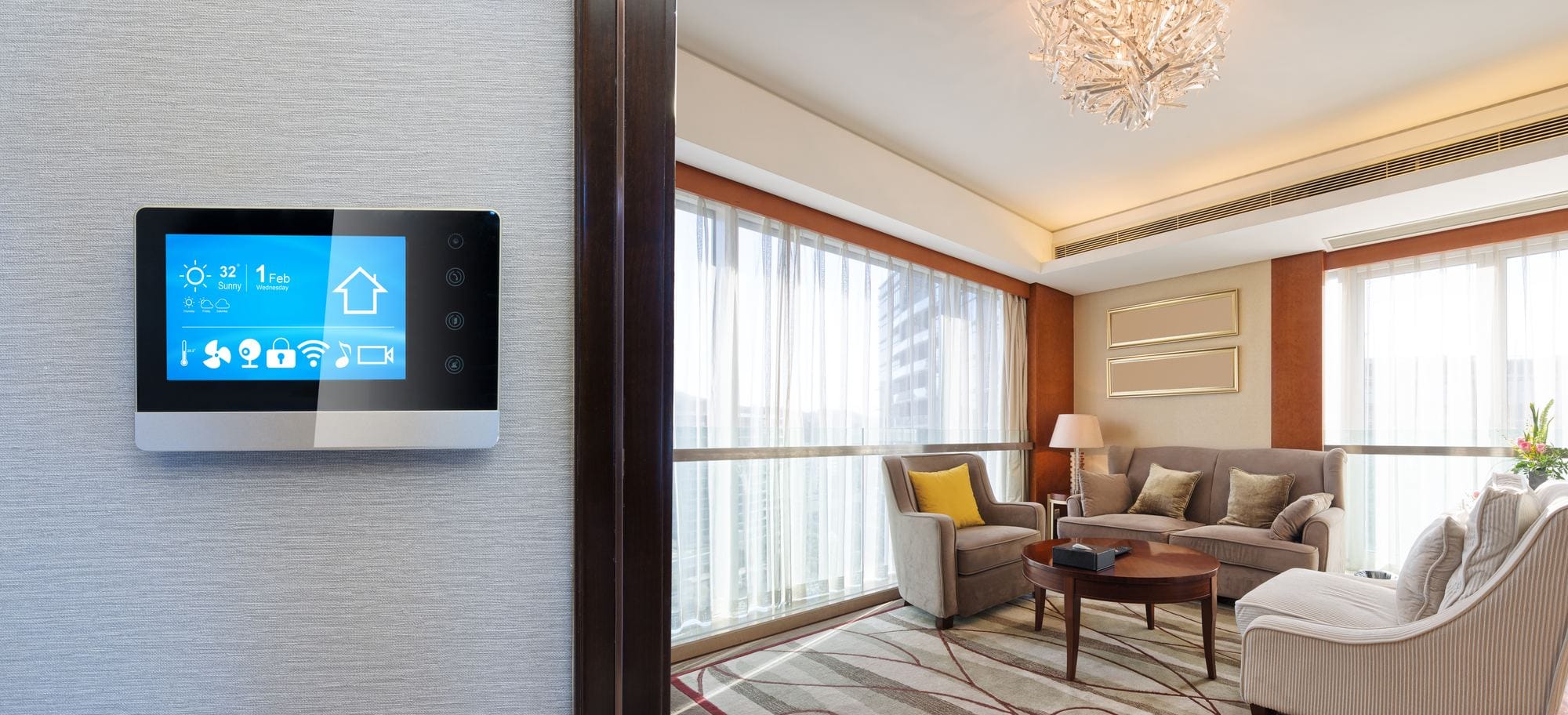
Smart building infrastructure, integrated at the electrical layer
Automation systems installed after the fact tend to fight the existing wiring. We integrate smart lighting, climate, and access control into the electrical design itself, so switches, circuits and controls work as one system.
Automation planned with the wiring
Automation systems installed after the fact tend to fight the existing wiring. We design smart lighting, climate, and access control into the electrical layout itself - for new builds and retrofits alike. That’s what keeps it reliable, instead of devices bolted onto circuits that weren’t built for them.
I don't think a smart home should feel complicated. If you have to think too much about the technology, then we have probably made it harder than it needs to be.
What can be automated in a connected property
Choose a category. Every system is scoped after an assessment.
Lighting is usually the first thing people automate. Behaviour depends on sensor placement, settings, connected loads and the control system you choose.
Smart lighting and scenes
Optional upgrade- What it does
- Control lights from switches, an app or voice, and recall saved scenes such as “evening” or “away”.
- Where it may suit
- Living areas, bedrooms and whole-home control.
Includes smart switches and dimmers, room-by-room and whole-home control, centralised control panels and compatible mobile apps. Dimmers must suit the lamps and drivers connected to them.
Schedules and dusk-to-dawn control
Optional upgrade- What it does
- Turn lights on and off at set times, or from dusk to dawn.
- Where it may suit
- Outdoor lights, entrances and gardens.
Schedules run from the control system. Daylight-triggered control needs a light sensor, covered under sensors below.
Motion-sensor lighting
Needs assessment- What it does
- Switch lights on when movement is detected and off after a set time.
- Where it may suit
- Corridors, staircases, bathrooms, garages and outdoor security lighting.
Sensors are chosen and placed for the area, because coverage, sensitivity and time-out decide how it behaves. Outdoor sensors need weather-rated units and care to avoid false triggers from vegetation, animals and passing traffic.
Occupancy and presence sensors
Needs assessment- What it does
- Keep lights on while a room is in use, and off when it is empty.
- Where it may suit
- Offices, bathrooms, meeting rooms and stores.
Ceiling-mounted occupancy sensors cover a room from above. Presence sensors, where supported, can detect very small movements such as someone sitting still. Not every system supports them.
Daylight sensors
Optional upgrade- What it does
- Measure natural light and dim or switch lights to suit.
- Where it may suit
- Rooms with large windows and offices.
Needs compatible dimmable lighting and sensor placement that reads the room, not the window.
Garden and landscape lighting control
Optional upgrade- What it does
- Switch and schedule external and landscape lighting.
- Where it may suit
- Gardens, driveways and compounds.
External circuits need weather-rated fittings, protection and correct earthing.
Lighting with alarm and access integration
Optional upgrade- What it does
- Light up an area when an alarm or supported access-control event occurs.
- Where it may suit
- Entrances, perimeters and gates.
Only possible where the alarm or access-control equipment can send a signal to the lighting controller. We confirm compatibility first.
Integration never replaces the independent safety and operational requirements of fire alarms, intruder alarms or access control, and safety functions are not switched off for convenience.
Lights that come on when you need them
Motion-sensor lighting suits corridors, staircases, bathrooms, garages and outdoor security lighting. How it behaves depends on where the sensor is placed, how it is set, what is connected and which control system you use, so we choose the sensor for the area.
Motion detection
Notices movement, then reports it or acts on it. Lights switch off after a time-out, which can leave a still person in the dark.
Occupancy detection
Aims to know whether a space is in use, usually by combining motion and a hold time. Better for rooms where people sit.
Presence detection
Can sense very small movement, such as someone sitting still, on supported sensors. It is more sensitive and not available on every system.
Daylight sensing
Measures natural light to dim or switch lights. It does not detect people at all.
Motion-sensor lighting is also available as outdoor security lighting that works with your alarm and cameras. See burglar and intruder alarms and CCTV.
What’s covered under home automation
Scope of work
- Automated lighting control and smart switch installation
- Centralized control panel and app integration
- Climate control automation
- Scene and scheduling configuration
- Integration with existing wiring or new-build circuits
How this work comes together
System design
Lighting, climate, and access control mapped against how the property is actually used and controlled.
Wiring & integration
Smart switches, control panels, and circuits wired into the existing or new-build electrical system.
Scene & scheduling setup
Scenes, schedules, and app control configured to match the agreed brief.
Commissioning
System tested end-to-end, including local operation, before handover.
Residential
Homes wired for Nigeria’s real grid conditions, for years after the inspection.
Commercial
Offices and retail fit-outs, where an electrical fault costs you trading hours.
Industrial
Factory and plant electrical infrastructure where downtime is measured in lost production.
Hospitality
Hotels, restaurants, and event venues where guests never see the electrical system, only whether it works.
Education
Schools and training facilities where a power failure stops lessons.
Healthcare
Clinics and healthcare facilities where backup power isn’t a convenience, it’s a patient-safety requirement.
Retail
Shops and showrooms where lighting quality and uptime directly affect the customer walking through the door.
Banking & Finance
Bank branches and financial institutions where a power fault stops transactions.
Telecommunications
Telecom infrastructure sites where an outage doesn’t just cost one building, it cost everyone connected to it.
Oil & Gas
Energy sector facilities where electrical faults carry safety stakes well beyond the immediate equipment.
Manufacturing
Factories and industrial plants where unplanned electrical downtime can stop the whole production line.
Assess, design, install, test & handover
Assess
Site survey, load assessment, and diagnostics. We measure the actual conditions before proposing a scope.
Design
A written design based on the assessed load: circuit schedules and single-line diagrams you keep.
Install
Work executed by our team to the documented design, with safety isolation and site protocols observed throughout.
Test & Handover
Commissioning tests, compliance checks, and as-built documentation handed over. Not just a completed job, a documented one.
Automation is only as good as the wiring behind it
A smart switch on a poorly designed circuit is still a poorly designed circuit. So we build automation into the electrical design itself: circuit layout, load calculations and control wiring.
Plan for the platform you actually want to use
Voice control, app control, and scene scheduling all depend on the control panel and hub you choose. We scope the electrical and control-panel infrastructure around your platform, so it works from day one without rework later.
New build vs. retrofit changes the approach
A new build lets us design wiring and control layout together. A retrofit works around your existing circuits, which usually means a site assessment first to confirm what can be automated without a full rewire.
Find the right home-automation systems
Answer a few questions for a preliminary list of the systems an assessment would cover. Nothing is sent until you submit our enquiry form.
Your property
Related services
- Automatic gates and access control →Gate motors, safety devices, intercoms and access control.
- CCTV and security systems →Cameras, recording and how they work with alarms and access.
- Burglar and intruder alarms →Sensors, panels and sirens that detect entry.
- Internet, fibre and networking →The network that connected devices rely on.
- Residential HVAC systems →Air conditioning, ventilation and compatible smart controls.
- Solar and inverter systems →Backup power for controllers and security equipment.
Common questions
Can automation be added to an existing property, or only new builds?
Both. New builds let us design the wiring and control layout together from the start, which is cleaner, but retrofitting smart lighting, climate, and access control into an existing property is a regular part of our scope too. It just needs a site assessment first to plan around the existing circuits.
Will a power outage disable the automation system?
Depends on the setup. Most smart lighting and control panels need power to function, same as any electrical system, so we discuss backup priorities (generator or inverter integration) as part of the design if outage resilience matters to you.
Do you work with a specific smart home platform?
We design the electrical and control-panel infrastructure to work with your chosen app or platform, so you aren't locked into one. Tell us what you're trying to control (lighting, climate, access, scenes) and we scope the electrical side accordingly.
Ready to design your smart building system?
Tell us what you want to control and we'll scope the electrical infrastructure to support it.